
Foundations That Drain Without Intervention
Grading and Site Preparation in Shawboro for residential builds, commercial lots, and drainage-dependent infrastructure
Proper grading eliminates standing water, directs runoff away from structures, and establishes a stable plane for construction. Southern Roots Land Development, Inc. provides precision grading and site preparation for residential, commercial, and solar installation projects throughout Shawboro and the Gates County corridor. You need this service when building a new structure, preparing a lot for sale, or correcting drainage failures that threaten existing improvements.
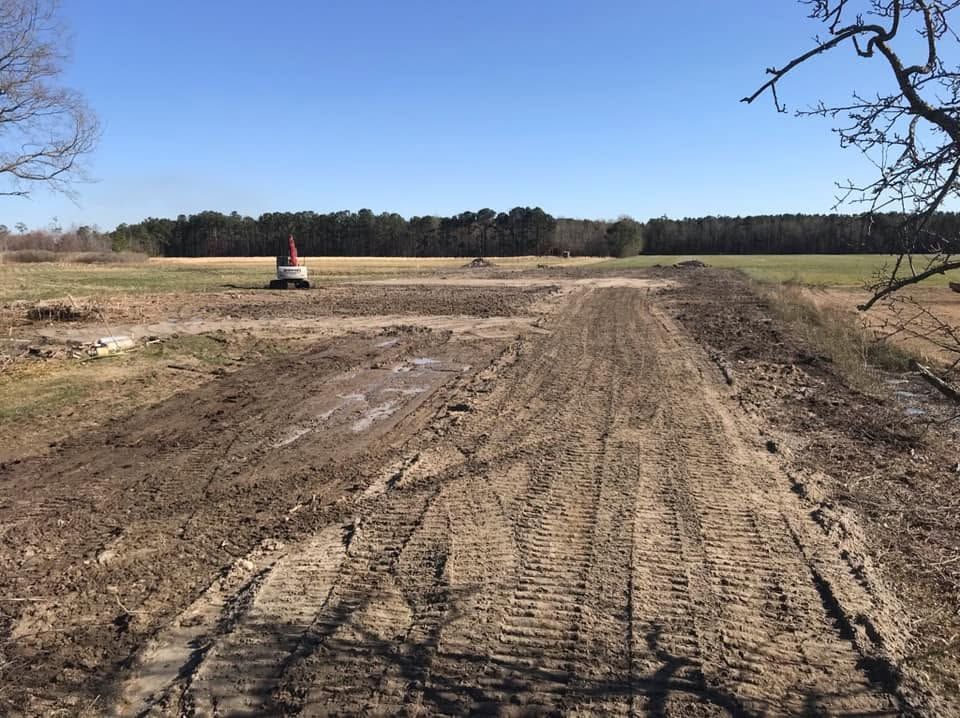
Site preparation begins with establishing reference elevations and identifying drainage outlets, then shaping soil to match design grades while compacting material in lifts. Northeastern North Carolina terrain often retains water due to flat topography and high water tables, which makes slope execution critical during the drizzling season. Equipment-based grading verifies slope consistency across the entire site rather than relying on visual estimates or hand tools.
Arrange an on-site consultation to review existing elevations and drainage requirements for your property.
Why Slope Consistency Prevents Long-Term Problems
Grading involves more than pushing dirt into approximate shapes—it requires verifying slope percentages, compaction density, and drainage plane alignment to prevent water retention. Solar field projects demand large-scale precision because panel arrays depend on uniform grades to avoid shading and water pooling beneath equipment. Southern Roots Land Development, Inc. uses equipment-based verification to ensure consistent slope execution across residential and commercial sites.
After grading is complete, you'll notice water moves predictably across the site during rain events, low spots no longer collect standing water, and the foundation area remains stable under equipment and material loads. Compacted soil resists rutting when delivery trucks access the site, and drainage paths direct runoff to designated outlets rather than neighboring properties or structure perimeters.
Site preparation also includes clearing vegetation from the work area, removing topsoil for stockpiling or redistribution, and establishing access routes that remain usable throughout the construction phase. Projects in the Hampton Roads service area often require coordination with utility installation and stormwater management plans, which affects grading sequencing and material placement.
Common Questions About Grading Work
Clients preparing building sites or addressing drainage problems typically ask about slope requirements, compaction standards, and how grading integrates with other site work.
What slope percentage is required for proper drainage?
Most building codes require a minimum slope of two percent away from structures for the first ten feet, though steeper grades may be necessary depending on soil type and site topography. In Shawboro, flat terrain often requires creating drainage swales or berms to direct water toward outlets when natural slope is insufficient.
How is soil compaction verified during grading?
Compaction is achieved by spreading soil in lifts and rolling each layer with equipment before adding the next. Verification typically involves visual inspection and equipment feedback, though engineered projects may require density testing with a nuclear gauge or similar instrument to confirm specifications are met.
When does grading happen relative to foundation work?
Grading occurs after excavation and before foundation forms are set or slabs are poured. Rough grading establishes the building pad and drainage plane, while finish grading happens after construction is complete to direct water away from the structure and prepare for landscaping.
What happens if existing grades direct water toward the building site?
Corrective grading involves reshaping soil to reverse the drainage direction, installing swales or berms to intercept runoff, or lowering surrounding areas to create positive drainage away from the foundation. Equipment-based grading ensures the corrected slope remains consistent across the entire affected area.
How does site preparation differ for commercial versus residential projects?
Commercial sites often require larger equipment, more precise tolerance verification, and coordination with engineered plans for stormwater management and utility placement. Solar field grading, for example, demands uniform slopes across multiple acres to prevent panel shading and ensure long-term stability beneath heavy equipment arrays.
Southern Roots Land Development, Inc. manages site preparation from initial clearing through final grade verification, coordinating equipment mobilization to match your construction timeline. Request a site assessment to identify drainage challenges and grading requirements specific to your project.